


You brush twice a day. Maybe you even floss most nights. So why does your dentist still find plaque at your cleaning appointments?
It’s a fair question and the honest answer has less to do with how well you’re brushing and more to do with what plaque actually is. Most people picture it as a thin film of food residue sitting on the tooth surface. Something a good scrub should handle. The reality is a lot more complex than that and once you understand it, your whole approach to oral hygiene starts to make more sense.
At Maryland Family & General Dentistry, we get this question regularly from patients at both our Silver Spring and Germantown offices. So here’s a real explanation not the oversimplified version.
Plaque Is Not Just Food Residue It’s a Living Structure
This is the part most people don’t know: plaque isn’t passive. It’s not just a layer of leftover food sitting on your enamel waiting to be brushed away.
Dental plaque is what scientists call a biofilm a structured, living community of bacteria, fungi, and microorganisms that organize themselves on the surface of your teeth. Over 700 species of bacteria have been identified in the human mouth, and many of them contribute to plaque in different ways and at different stages.
Think of it less like dust on a shelf and more like a colony with its own architecture. The bacteria inside plaque communicate with each other, share nutrients, and critically protect each other from outside threats. That protection is exactly why your toothbrush can only go so far.
How Plaque Actually Forms Step by Step
Understanding how plaque builds is key to understanding why it’s so hard to fully control at home.
Step 1: The Pellicle Forms
Within minutes of brushing your teeth, a thin protein layer from your saliva coats the tooth surface. This is called the acquired pellicle. It sounds harmless and on its own, it is. But it acts as an attachment surface that certain bacteria are specifically designed to grab onto.
Step 2: Early Bacteria Move In
Bacteria like Streptococcus mutans one of the primary culprits in tooth decay are among the first to attach to the pellicle. These early settlers aren’t immediately destructive, but they start producing sticky substances that make it easier for other bacteria to join.
Step 3: The Biofilm Matures
As more bacteria attach and multiply, they secrete a protective matrix of sugars and proteins around themselves. This matrix called extracellular polysaccharide is essentially a shield. It holds the community together and makes the entire biofilm significantly more resistant to being disrupted.
This is why a biofilm behaves so differently from free-floating bacteria. The same bacteria that antibiotics or mouthwash might easily kill when floating freely become dramatically harder to eliminate once they’re embedded in a mature biofilm.
Step 4: Anaerobic Bacteria Take Over the Deeper Layers
As the biofilm thickens, the bacteria in the outer layers consume the available oxygen. This creates an oxygen-poor environment deeper in the plaque exactly the conditions that more aggressive, harmful anaerobic bacteria prefer. These are the bacteria most closely linked to gum disease and bone loss.
By this point, you’re not dealing with a surface-level problem anymore.
Why Your Toothbrush Can’t Do It All
Your toothbrush is genuinely effective but only against plaque that hasn’t fully matured and only on surfaces it can physically reach. Here’s where it falls short:
Between the teeth. The bristles of a standard toothbrush simply cannot reach into the contact points between teeth. This is not a technique problem. It’s a geometry problem. Floss, interdental brushes, and water flossers exist precisely because brushing physically cannot access these spaces.
Below the gum line. Plaque doesn’t just form on the visible part of the tooth. It forms at and below the gum line in a space called the sulcus where no toothbrush can reach without causing damage to the tissue. This is where subgingival plaque builds up, and where the most harmful anaerobic bacteria thrive.
Once it hardens into tartar. Plaque that sits undisturbed for 24 to 72 hours begins to mineralize it absorbs calcium and phosphate from saliva and hardens into tartar, also called calculus. Once that happens, no amount of brushing will remove it. It physically bonds to the tooth surface and can only be removed by a dental professional with scaling instruments. This is not a marketing pitch it is just how the chemistry works.
The biofilm resistance factor. Even on accessible surfaces, a mature biofilm is significantly more resistant to disruption than fresh plaque. The protective matrix surrounding the bacteria reduces the mechanical effectiveness of brushing and limits how deeply antibacterial agents in toothpaste can penetrate.
What Professional Cleaning Actually Does
When you come in for a cleaning at our Silver Spring or Germantown dental office, the hygienist isn’t just polishing your teeth. They’re doing something your toothbrush is physically incapable of doing.
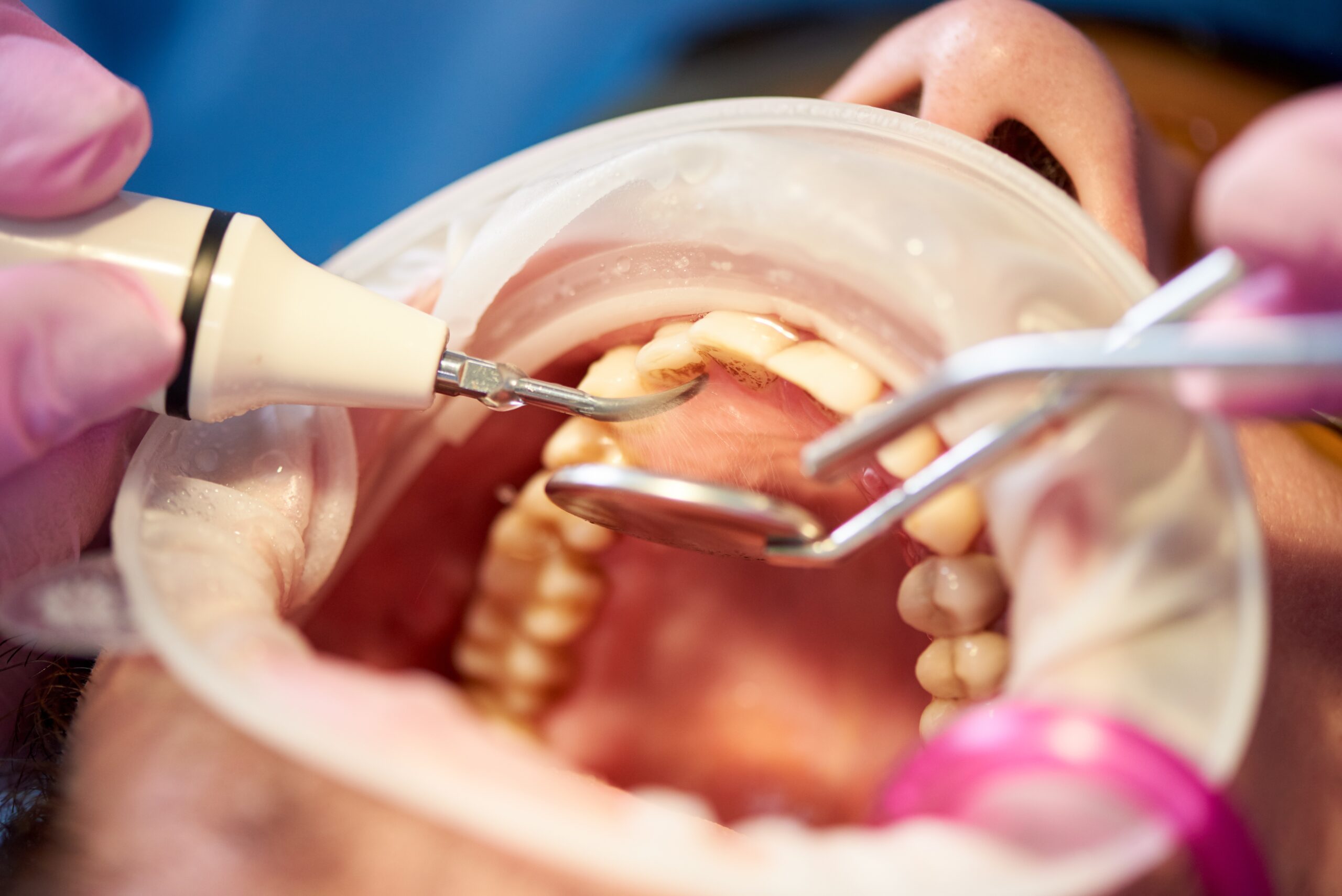
Professional scaling removes hardened tartar from both above and below the gum line. The instruments used either hand scalers or ultrasonic devices break apart the mineralized deposits that have bonded to the tooth surface and disrupt the biofilm structure in areas your brush can’t reach. This is why professional cleanings remain necessary even for people who brush and floss consistently. It’s not a commentary on your habits. It’s an acknowledgment of what at-home tools are structurally capable of.
For patients with early gum disease, a deeper procedure called periodontal scaling and root planning goes further cleaning below the gum line and smoothing the root surface to discourage bacterial reattachment. Any dentist in Silver Spring or Germantown will recommend this based on pocket depth measurements taken during your exam, not based on guesswork.
What Happens When Plaque Is Left Alone
Most people have heard that plaque causes cavities and gum disease. But understanding the mechanism makes it more concrete.
The bacteria in plaque particularly the acid-producing ones feed on sugars and fermentable carbohydrates from your diet. As they metabolize these sugars, they produce acid as a byproduct. That acid sits against the tooth surface and, over time, begins to dissolve the mineral structure of the enamel. That’s a cavity forming.
Below the gum line, the story is different. The harmful anaerobic bacteria in subgingival plaque produce toxins rather than acid. Those toxins trigger an immune response in the surrounding gum tissue and that immune response, as much as the bacteria themselves, is what causes the inflammation, bleeding, and eventual bone loss associated with periodontitis.
This is why early-stage gum disease is reversible but advanced gum disease is not. Once bone loss occurs, the bone doesn’t grow back. The goal shifts from recovery to stabilization.
What You Can Actually Control at Home
None of this is meant to make brushing feel pointless it’s absolutely not. Consistent brushing and flossing is what keeps plaque in the early, less organized stages where it’s most disrupted. Here’s what actually moves the needle:
Brush for two full minutes, twice a day. Most people brush for 45 seconds. Technique matters less than coverage and time.
Floss or use an interdental tool daily. If you genuinely cannot tolerate flossing, a water flosser is a clinically supported alternative. What isn’t an alternative is skipping interdental cleaning altogether that’s where a significant percentage of cavities and gum disease originates.
Don’t skip cleanings. For most adults, every six months is the standard. For patients with a history of gum disease or heavy tartar buildup, every three to four months is more appropriate. Your dentist in Silver Spring or your dentist in Germantown will tell you which schedule is right for your mouth specifically.
Watch your diet between meals. Every time you eat or drink something sugary or acidic, the bacteria in plaque get a fresh food supply and your enamel takes a short acid hit. Frequency matters more than quantity sipping a soda over two hours is harder on your teeth than drinking it in ten minutes.
A Note From Our Silver Spring and Germantown Offices
We share this because we think patients make better decisions when they understand what’s actually happening not just what they’re supposed to do. The “brush and floss” message is right, but it’s incomplete without understanding why professional care fits into the picture.
If it’s been a while since your last cleaning, or if you’ve been noticing bleeding, sensitivity, or buildup that concerns you, come in and let us take a look. Dr. Jamaad Abdi and Dr. Nathanael Dejene and our hygiene team at both our Silver Spring, MD and Germantown, MD locations are here to give you a clear picture of where things stand no pressure, just an honest conversation about your mouth.
Frequently Asked Questions
Q: How quickly does plaque form after brushing?
Faster than most people expect. A thin protein layer from your saliva begins coating your teeth within minutes of brushing. Bacteria start attaching to that layer almost immediately, and a recognizable plaque biofilm can begin forming within a few hours. This is why brushing before bed matters overnight, with reduced saliva flow, plaque has several hours to develop undisturbed. A dentist in Silver Spring will typically see a direct connection between patients who skip nighttime brushing and higher rates of decay.
Q: Can mouthwash replace flossing if I use it every day?
Not really, and here’s why. Most antibacterial mouthwashes work well against free-floating bacteria in saliva but plaque is a biofilm, and the protective matrix surrounding bacteria in a mature biofilm significantly limits how deeply liquid antiseptics can penetrate. Mouthwash is a useful addition to a routine, not a replacement for the mechanical disruption that flossing or an interdental brush provides. This is a common misconception our team at our Germantown dental office addresses regularly.
Q: What does tartar actually look like, and how do I know if I have it?
Tartar hardened plaque is typically pale yellow, brown, or grey and most commonly appears along the gum line on the back of the lower front teeth and around the upper molars. You may be able to feel a rough or hardened edge in those areas with your tongue. Some people can see it clearly; others can’t without magnification. Either way, once tartar has formed, a professional cleaning is the only way to remove it. If you’re noticing buildup between visits, mention it to your dentist in Silver Spring or Germantown they can assess how quickly it’s forming and whether your cleaning frequency needs to be adjusted.
Q: Is plaque the same thing as the white film I feel on my teeth in the morning?
That morning film is partially plaque but also includes a mix of dead cells, mucus, and bacterial waste that accumulates overnight as saliva production decreases. It’s not the same as a fully developed biofilm, which is why morning brushing is relatively effective at clearing it. The more concerning plaque is the kind that has had days to mature in areas between teeth and below the gum line the kind you can’t feel and can’t see.
Q: How often should I really be getting my teeth cleaned if I brush and floss every day?
Every six months is the general recommendation, but it’s genuinely not one-size-fits-all. People who produce tartar quickly, have a history of gum disease, smoke, have diabetes, or have deep gum pockets may need cleanings every three to four months to stay ahead of the problem. People with naturally slow plaque formation and no history of gum issues may do fine at six months. The best answer comes from your specific exam findings. Our dentists in Silver Spring and Germantown assess this individually rather than applying a blanket schedule because what your mouth needs depends on what’s actually happening in it.